DigitalOcean · Opus 5.5 · medium effort · HIPAA organization · trial 1
Real-Time Collaborative App on DigitalOcean
Success
Deployed to https://adb-wf7uo-realtime-5cs45.ondigitalocean.app. Every deployment is deleted after it's verified and reviewed.
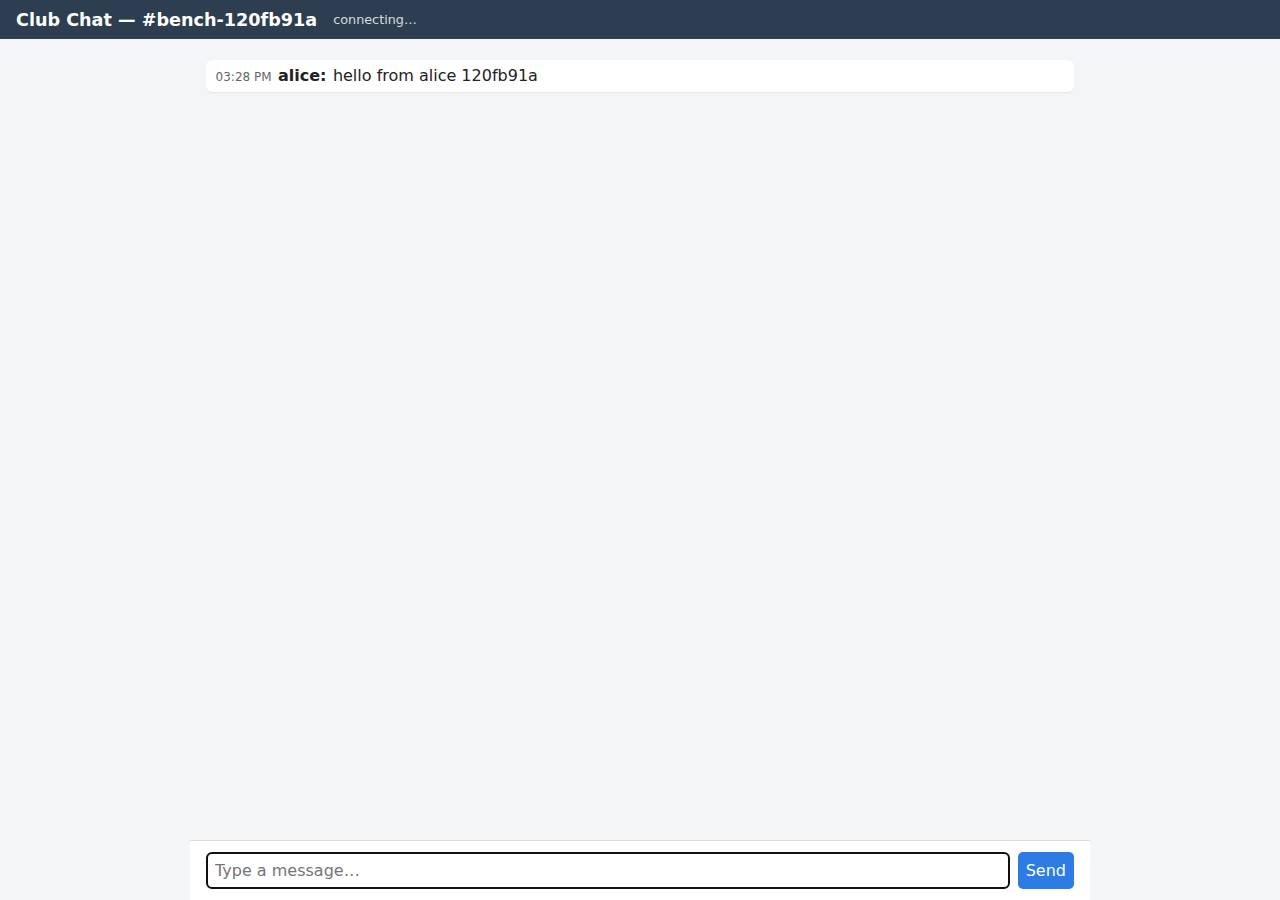
Screenshots
Technologies
- Runtime
- Node.js 22
- Frameworks
- Node.js http module (built in)
- Libraries
- ws
- Packaging
- Docker (node:22-alpine)App spec (.do/app.yaml)
- Hosting
- App Platform service (apps-s-1vcpu-0.5gb)DigitalOcean Container Registry (starter)
Named from the app's dependencies, Dockerfile and config files, and the cloud resources it created.
Checks
Black-box checks against the live URL. A cell succeeds when every required check passes. The app's spec
| Result | Check | Details |
|---|---|---|
| passed | GET / answers 2xx within 1 min ready |
|
| passed | The app is served over HTTPS with a valid certificate https |
|
| passed | The app is public: no redirect to another host such as a login page public_access |
|
| passed | GET / serves the chat UI as HTML ui |
|
| passed | deployment.json declares a supported transport (websocket or sse) transport optional |
|
| passed | Clients connect over websocket connect |
|
| passed | A message reaches another client in the same room within 5 s delivery |
|
| passed | The sender receives its own message too echo optional |
|
| passed | Messages never reach clients in other rooms room_isolation |
|
| passed | Five users posting at the same time all see every message within 10 s fanout |
|
| passed | GET /api/rooms/<room>/messages returns recent messages history |
|
| passed | Messages over 1000 characters are rejected validation optional |
|
| passed | The chat UI loads in a browser without errors browser_ui optional |
Human steps
- Sign up for an account and verify the email address · 3 min
prerequisite: account setup - Add a payment method to the account · 2 min
prerequisite: account setup - Create an API token and hand it to the agent · 2 min
prerequisite: account setup
Security & compliance review
An independent Claude Code session reviewed the source, the agent's sessions and the live deployment against a fixed rubric (claude-opus-5-5, high effort).
A small, carefully built Node/ws chat app on a paid DigitalOcean App Platform Basic instance. The app needs no secrets, the container runs as non-root, nothing beyond the app is exposed, HTTPS is enforced, and the hosting fits personal use. The main weaknesses are provenance (an unpinned base image, a mutable v1 image tag, and builds pushed from the agent's local workspace), plus minor app-level gaps: no security headers, no rate limiting, unbounded in-memory room creation, and no Origin check on WebSocket upgrades.
| Criterion | Weight | Score | Why |
|---|---|---|---|
| Secrets handling | 25 | 10/10 | The app needs no secrets and none were created. The DigitalOcean token was only referenced as $DIGITALOCEAN_ACCESS_TOKEN in deploy commands and never printed, and no credentials appear in the source, the image or the app spec. |
| Deployment provenance | 20 | 6/10 | The image was built from the local workspace and pushed to the owner's private DOCR, so production runs the code that was built. But the base image is an unpinned tag (node:22-alpine), the app spec deploys a mutable tag (v1) instead of a digest, there's no source repository or CI, and doctl was downloaded with no checksum check. |
| Terms compliance | 15 | 10/10 | The app is for personal use. It runs on a paid App Platform Basic instance ($5/month), which doesn't sleep or expire, and uses the free DOCR Starter tier for its single ~61 MB repository, which is within that tier's limits. As far as I know, DigitalOcean's terms allow this use. |
| Least privilege | 15 | 10/10 | The container runs as the non-root node user. The registry is private, there's no data store, and the only public resource is the single App Platform service. |
| Transport security | 10 | 8/10 | The app is served over HTTPS with a valid Google Trust Services certificate (valid to Dec 22, 2026), and HTTP returns a 301 redirect to HTTPS. The app sets no HSTS, X-Content-Type-Options, frame-protection or CSP headers, though it could easily have done so. |
| Attack surface | 10 | 10/10 | Probes for .env, .git, source files, the Dockerfile and admin paths all return a generic JSON 404. Errors return no stack traces, and the only extra endpoint is a harmless /health. |
| Application security | 5 | 7/10 | Input validation is solid: room-name regex, message and name length limits, a body-size cap, a WebSocket maxPayload and safe JSON errors. The UI renders with textContent, so there's no XSS. However, the app has no rate limiting, any request can create a new in-memory room without limit, and WebSocket upgrades don't check the Origin header. |
Findings
-
medium deployment Base image and deployed image not pinned by digest
Evidence: app/Dockerfile:1 `FROM node:22-alpine`; app/.do/app.yaml uses `tag: v1` (process/resources.json image.tag "v1"), a mutable tag that can be overwritten in DOCR
Fix: Pin the base image as node:22-alpine@sha256:<digest> and deploy the pushed image by digest (image.digest in the app spec), or use unique immutable tags.
-
medium app Unbounded room creation and no rate limiting
Evidence: server.js:19-26 getRoom() inserts a new room into the global Map for any valid name, and it is called even on GET /api/rooms/<room>/messages (server.js:131) and for SSE connections; rooms are never removed, and there is no per-client limit on POSTs, WebSocket messages or connections
Fix: Create rooms only when messages are posted, evict empty rooms, cap the room count, and add per-IP rate limits on posts, WebSocket messages and connections.
-
low deployment Built from local workspace with no source-controlled pipeline
Evidence: process/deploy.md: `docker build ... -t registry.digitalocean.com/adb-wf7uo-realtime/adb-wf7uo-realtime-web:v1 . && docker push` run from the agent's machine; no git repository or CI involved
Fix: Build and deploy from a repository the owner controls (App Platform GitHub source, or a CI pipeline that pushes digest-tagged images).
-
low deployment Deploy tool downloaded without integrity verification
Evidence: process/deploy.md: `curl -sL https://github.com/digitalocean/doctl/releases/download/v1.146.0/doctl-1.146.0-linux-amd64.tar.gz | tar xz && sudo mv doctl /usr/local/bin/`, with no checksum check
Fix: Verify the release checksum file, or install doctl from a signed package source.
-
low app No security headers
Evidence: GET https://adb-wf7uo-realtime-5cs45.ondigitalocean.app/?room=general returns only content-type, cache-control and the platform/Cloudflare headers: no Strict-Transport-Security, X-Content-Type-Options, X-Frame-Options/frame-ancestors or Content-Security-Policy (server.js:112)
Fix: Set HSTS, X-Content-Type-Options: nosniff, a CSP with frame-ancestors 'none', and Referrer-Policy in sendJson and the index handler.
-
low app WebSocket upgrade does not check Origin
Evidence: server.js:184-199 accepts upgrades without inspecting the Origin header; an upgrade request with `Origin: https://evil.example` to /ws?room=review&user=rev returned 101
Fix: Reject upgrades whose Origin is not the app's own host, so third-party pages can't open sockets for visitors.
-
info deployment Dependencies installed from lockfile
Evidence: app/Dockerfile:4-5 `COPY package*.json ./` and `RUN npm ci --omit=dev`; the only runtime dependency is ws ^8.22.0 (app/package.json)
Fix: No action needed; keep committing package-lock.json.
-
info app Output encoding prevents XSS
Evidence: app/public/index.html:74-75 builds messages with createElement/textContent; a POST with user `<img src=x>` and blank text was rejected 400 by validText (server.js:39-41)
Fix: No action needed.
-
info deployment Container runs as non-root
Evidence: app/Dockerfile:10 `USER node`
Fix: No action needed.
-
info app No sensitive files or debug endpoints exposed
Evidence: GET /.env, /.git/config, /package.json, /server.js, /Dockerfile and /admin all returned 404 {"error":"not found"}; server.js:170 is a catch-all 404, and server.js:177 returns a generic 500
Fix: No action needed.
-
info deployment No secrets required or leaked
Evidence: process/deploy.md uses the token only as `$DIGITALOCEAN_ACCESS_TOKEN` in curl headers; app/.do/app.yaml has no envs; .dockerignore excludes .git and .env is gitignored
Fix: No action needed; add .env to .dockerignore as well, as defense in depth.
Cloud resources and cost
| Traffic | Per month | How it was priced |
|---|---|---|
| Light use Barely used: a few visits a week, about 2,000 requests a month. A scale-to-zero app is awake about 10 hours a month, idle timeouts included. | $5.00 | fixed monthly prices; 0.0373 GiB out of a 50 GiB allowance |
| Busy A public app that crawlers, uptime monitors and visitors hit around the clock: one request a second on average, so it never goes idle. | $5.00 | fixed monthly prices; 49 GiB out of a 50 GiB allowance |
Resources the agent created
| Kind | Name | Plan | List price / month | Pricing |
|---|---|---|---|---|
| app | adb-wf7uo-realtime | adb-wf7uo-realtime-web: apps-s-1vcpu-0.5gb x 1 | $5.00 | adb-wf7uo-realtime-web: apps-s-1vcpu-0.5gb x 1 |
| registry | adb-wf7uo-realtime | starter | $0.00 | Container Registry starter tier (one per account) |
The agent estimated $5.00 a month.
Code
- Code
- 486 lines in 10 files (JavaScript 345, HTML 130, JSON 29, Markdown 16, YAML 16, Docker 11)
- Dependencies
- 1 npm, 0 Python
- Deploy config
Dockerfile.dockerignore.do/app.yaml
The agent's sessions
| Phase | Status | Time | Turns | Tokens | Cost | Shell commands |
|---|---|---|---|---|---|---|
| Build | completed | 1m 58s | 12 | 423.8K | $0.42 | 8 |
| Deploy | completed | 1m 44s | 7 | 335.0K | $0.18 | 6 |
The agent's deploy summary
The chat app is live at https://adb-wf7uo-realtime-5cs45.ondigitalocean.app over HTTPS, and every requirement in TASK.md worked when I tested it through that URL.
What I deployed (about $5/month):
- Container registry:
adb-wf7uo-realtimeon the free starter tier, in nyc3. I built the Docker image locally and pushed it there asadb-wf7uo-realtime-web:v1. - App Platform app:
adb-wf7uo-realtime(idd1340407-bcac-4f7c-8ded-82851d8e8b53). It runs one instance of the smallest paid size,apps-s-1vcpu-0.5gb, which costs $5/month. DigitalOcean provides the HTTPS certificate, and the health check uses/health. The app configuration is saved in.do/app.yaml.
What I tested on the public URL:
- The web UI returns 200.
- Posting a message over HTTP returns
201; empty text and text over 1000 characters both return400. - The history endpoint returns the room's messages in the expected shape.
- WebSocket (
wss://…/ws): four clients sent 20 messages at the same time, and every client received all 20 within 60 ms. An invalid message got anerrorreply, and a client in another room received nothing. - Server-Sent Events: the stream delivered a posted message.
deployment.json is written, with realtime set to WebSocket at wss://adb-wf7uo-realtime-5cs45.ondigitalocean.app/ws. Nothing needed a person, so human_steps is empty. I didn't create any credentials, so there's no .env file; I added .env to .gitignore anyway.
Limitation: message history is kept in memory. It's wiped on every redeploy or restart, and the app has to stay at one instance, because a second instance wouldn't share rooms with the first.
6 shell commands during deploy
- 10s
git diff --no-index /dev/null server.js | head -0; grep -n "MAX_ROOM\|module.exports" server.js; which doctl; curl -s -H "Authorization: Bearer $DIGITALOCEAN_ACCESS_TOKEN" https://api.digitalocean.com - 14s
cd /tmp && curl -sL https://github.com/digitalocean/doctl/releases/download/v1.146.0/doctl-1.146.0-linux-amd64.tar.gz | tar xz && sudo mv doctl /usr/local/bin/ && doctl version && doctl registry optio - 18s
doctl registry create adb-wf7uo-realtime --subscription-tier starter --region nyc3 && doctl registry login --expiry-seconds 3600 >/dev/null && docker build -q --platform linux/amd64 -t registry.digita - 40s
mkdir -p .do && cat > .do/app.yaml <<'EOF' - 1m 23s
U=https://adb-wf7uo-realtime-5cs45.ondigitalocean.app - 1m 37s
echo ".env" >> .gitignore && doctl registry get -o json | python3 -c "import sys,json;print(json.load(sys.stdin))" 2>/dev/null | head -c 300; echo; cat > deployment.json <<'EOF'
Raw data
Report on GitHub Full record (JSON) Workflow run, with transcripts