Render · Opus 5.5 · medium effort · HIPAA organization · trial 1
Database-Backed CRUD App on Render
Success
Deployed to https://adb-9mnhm-crud-web.onrender.com. Every deployment is deleted after it's verified and reviewed.
Screenshots
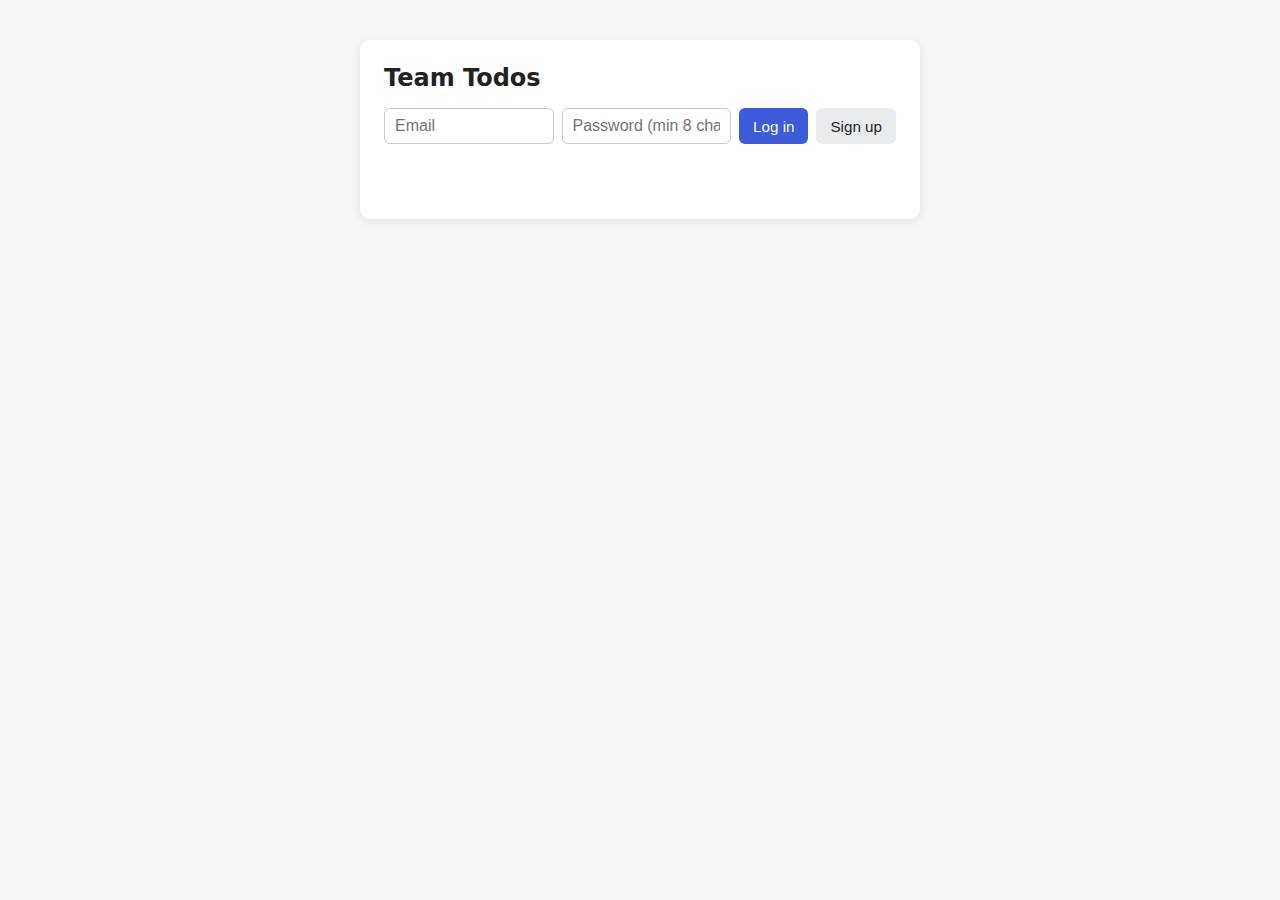
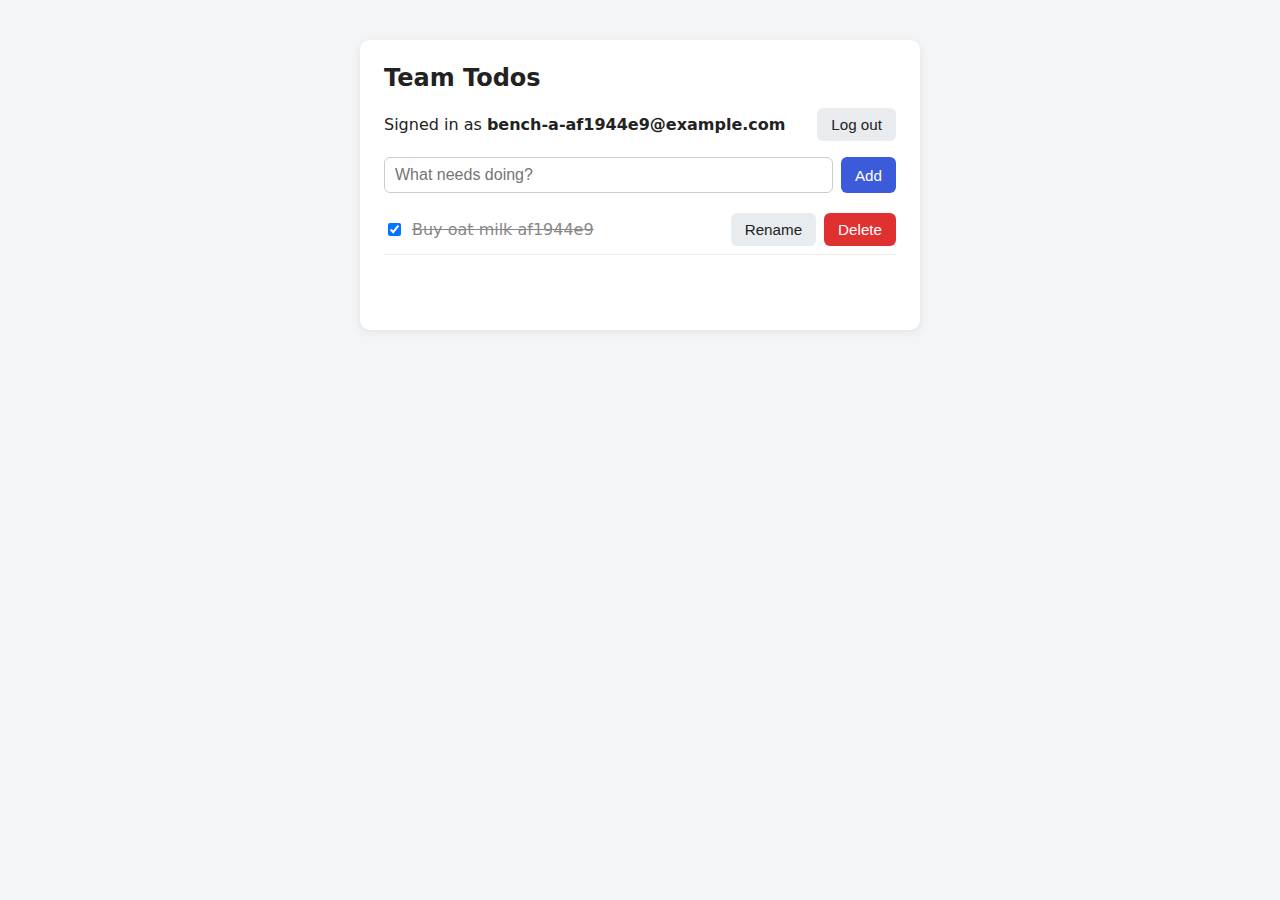
Technologies
- Runtime
- Node.js 22
- Frameworks
- Express
- Data
- PostgreSQL (Render Postgres, free)
- Libraries
- node-postgresbcrypt.js
- Packaging
- Render Blueprint (render.yaml)
- Hosting
- Render web service (free, running the prebuilt image node:22-alpine)
Named from the app's dependencies, Dockerfile and config files, and the cloud resources it created.
Checks
Black-box checks against the live URL. A cell succeeds when every required check passes. The app's spec
| Result | Check | Details |
|---|---|---|
| passed | GET / answers 2xx within 1 min ready |
|
| passed | The app is served over HTTPS with a valid certificate https |
|
| passed | The app is public: no redirect to another host such as a login page public_access |
|
| passed | GET / serves the web app as HTML ui |
|
| passed | POST /api/auth/signup creates an account and returns a token signup |
|
| passed | Signup rejects an invalid email and a short password with 400 signup_validation |
|
| passed | Signing up twice with the same email returns 409 signup_duplicate |
|
| passed | POST /api/auth/login returns a token login |
|
| passed | Login with a wrong password returns 401 login_wrong_password |
|
| passed | /api/todos requires a valid token (401) auth_required |
|
| passed | POST /api/todos creates a todo create |
|
| passed | An empty title is rejected with 400 create_validation |
|
| passed | GET /api/todos lists the caller's todos list |
|
| passed | Todos are listed oldest first list_order optional |
|
| passed | PATCH /api/todos/{id} renames and completes a todo update |
|
| passed | Users can't see or modify each other's todos (404) isolation |
|
| passed | DELETE /api/todos/{id} removes a todo delete |
|
| passed | Data is still there a minute later, with a fresh login persistence |
|
| passed | The web UI renders a login or signup form browser_ui optional |
Human steps
- Sign up for an account and verify the email address · 3 min
prerequisite: account setup - Create an API token and hand it to the agent · 2 min
prerequisite: account setup
Security & compliance review
An independent Claude Code session reviewed the source, the agent's sessions and the live deployment against a fixed rubric (claude-opus-5-5, high effort).
The app code is solid: queries are parameterized, passwords use bcrypt, tokens are hashed, users can only reach their own todos, and the live site serves HTTPS with nothing sensitive exposed. The deployment is weaker. A commercial app runs on Render free plans, and the free database expires on 2026-11-13, taking the data with it. The database is open to the internet, and the code was shipped as a secret-file tarball on an unpinned node:22-alpine image that runs npm ci as root at every start, so the running code can't be traced to source.
| Criterion | Weight | Score | Why |
|---|---|---|---|
| Secrets handling | 25 | 9/10 | The Render API key came from the environment and never appeared in transcripts. DATABASE_URL was given to the service as a Render env var and read through process.env, and the uploaded bundle left out .env. Minor point: the external DB connection string was also written to a local .env on the runner. |
| Deployment provenance | 20 | 4/10 | Production code is a base64 tarball uploaded as a Render secret file and unpacked at container start, so there is no source repo or build record linking it to reviewed sources. The base image is the floating tag node:22-alpine with no digest, and npm ci pulls dependencies from the registry on every boot. The lockfile does pin versions. |
| Terms compliance | 15 | 3/10 | This is a commercial app on Render's free web and Postgres plans. Render says free instances are for hobby and testing, not production. The free database expires on 2026-11-13 and takes the persistent data the app needs with it, and the free web service sleeps when idle. |
| Least privilege | 15 | 5/10 | The Postgres instance was created with no IP allow list, so it accepts connections from the internet (the agent connected from the CI runner using the external URL). The container runs as root in the stock node image, and the app connects as the database owner. |
| Transport security | 10 | 7/10 | HTTPS works with a valid certificate, and HTTP gets a 301 redirect to HTTPS. The app sets no HSTS, X-Content-Type-Options, frame protection or CSP, though it could have added them in Express. |
| Attack surface | 10 | 9/10 | Requests for .env, .git, package.json, source files and the bundle all return 404, and errors return generic messages. The only leak is the X-Powered-By: Express header. |
| Application security | 5 | 7/10 | Queries are parameterized, passwords use bcrypt cost 12, tokens are random and stored hashed, ownership is checked, input is validated, and the UI renders with textContent. There is no rate limiting on login or signup, and the bearer token is kept in localStorage while no CSP is set. |
Findings
-
high deployment Commercial app on Render free plans; free Postgres expires
Evidence: process/context.json use=commercial; process/resources.json: service plan 'free', postgres plan 'free' with expires_at 2026-11-13T02:14:22Z; deployment.json notes 'Free Postgres expires after 30 days' and 'Free web service spins down when idle'
Fix: Use paid Render plans (e.g. Starter web service and a Basic Postgres) for a business's app, so data persists past 30 days and the service doesn't sleep.
-
medium deployment Postgres reachable from the public internet
Evidence: process/deploy.md line 87 area: POST /v1/postgres body has no ipAllowList (Render's default allows 0.0.0.0/0); deploy.md line 245: the agent connects from the GitHub runner with EXTERNAL_DATABASE_URL
Fix: Set the database's ipAllowList to empty (internal-only) or to specific admin IPs. The app already uses the internal connection string.
-
medium deployment Code delivered as an opaque secret-file tarball, not from source control
Evidence: process/deploy.md: tar czf /tmp/app.tgz ... | base64 uploaded as secretFiles app.tgz.b64; start.sh runs 'base64 -d /etc/secrets/app.tgz.b64 | tar xz; npm ci; exec node src/server.js'. render.yaml (runtime node, Git build) does not match what is deployed.
Fix: Deploy from a Git repo the owner controls (Blueprint/render.yaml) or a pinned image built in CI and pushed to a registry the owner controls, so every deploy traces back to a commit.
-
medium deployment Unpinned base image; dependencies installed at runtime on every start
Evidence: process/deploy.md: image.imagePath 'docker.io/library/node:22-alpine' (tag, no digest); start.sh runs 'npm ci --omit=dev' at container boot
Fix: Pin the base image by digest and install dependencies at build time, so the running artifact is immutable and reproducible.
-
low deployment Container runs as root
Evidence: The stock node:22-alpine image runs as root by default; dockerCommand 'sh /etc/secrets/start.sh' never switches user (no USER node)
Fix: Run as the non-root 'node' user, e.g. with a Dockerfile containing USER node.
-
low app Missing security headers
Evidence: curl -sI https://adb-9mnhm-crud-web.onrender.com/ returns no Strict-Transport-Security, X-Content-Type-Options, X-Frame-Options or Content-Security-Policy
Fix: Add helmet (or set the headers by hand) in src/app.js, including HSTS and a strict CSP.
-
low app No rate limiting on auth endpoints
Evidence: app/src/app.js lines 109-141: signup and login have no throttling or lockout
Fix: Add per-IP and per-account rate limiting (e.g. express-rate-limit) to /api/auth/*.
-
low app Bearer token stored in localStorage
Evidence: app/public/index.html line 57/71: localStorage.setItem('token', t); an HttpOnly cookie is also set
Fix: Rely on the HttpOnly cookie for the browser UI, or add a strict CSP to limit the impact of any XSS.
-
low deployment DB TLS verification disabled for external connections
Evidence: app/src/db.js line 10: ssl: { rejectUnauthorized: false }
Fix: Verify the server certificate, or use only the internal connection over Render's private network.
-
info app X-Powered-By header discloses framework
Evidence: curl -sI / shows 'x-powered-by: Express'
Fix: Add app.disable('x-powered-by').
-
info deployment External DB connection string written to local .env
Evidence: process/deploy.md line 99: writes DATABASE_URL and EXTERNAL_DATABASE_URL to .env (gitignored; not in the uploaded tarball)
Fix: Avoid saving production credentials on build machines. If you do, delete them after the deploy.
Cloud resources and cost
| Traffic | Per month | How it was priced |
|---|---|---|
| Light use Barely used: a few visits a week, about 2,000 requests a month. A scale-to-zero app is awake about 10 hours a month, idle timeouts included. | $0.00 | fixed monthly prices; 0.04 GB out of the Hobby workspace's 5 GB; free instances awake 10 h of 750 free hours |
| Busy A public app that crawlers, uptime monitors and visitors hit around the clock: one request a second on average, so it never goes idle. | $7.13 | fixed monthly prices; 52.6 GB out of the Hobby workspace's 5 GB, 47.6 GB billed (with a payment method on file; without one Render suspends the services instead); free instances awake 730 h of 750 free hours |
Resources the agent created
| Kind | Name | Plan | List price / month | Pricing |
|---|---|---|---|---|
| service | adb-9mnhm-crud-web | free | $0.00 | free x 1 instance(s) |
| postgres | adb-9mnhm-crud-db | free | $0.00 | Postgres free |
The agent estimated $0.00 a month.
Code
- Code
- 441 lines in 10 files (JavaScript 301, HTML 140, JSON 34, YAML 20, Markdown 13)
- Dependencies
- 3 npm, 0 Python
- Deploy config
render.yaml
The agent's sessions
| Phase | Status | Time | Turns | Tokens | Cost | Shell commands |
|---|---|---|---|---|---|---|
| Build | completed | 1m 58s | 11 | 435.0K | $0.44 | 8 |
| Deploy | completed | 10m 41s | 15 | 792.0K | $0.54 | 14 |
The agent's deploy summary
The app is live at https://adb-9mnhm-crud-web.onrender.com and costs $0 a month.
What's running on Render:
- Web service
adb-9mnhm-crud-web(srv-db7ebb7avr4c73ftvb1g), free plan. - PostgreSQL 16
adb-9mnhm-crud-db(dpg-db7eavivcj2c73db3fs0-a), free plan. The service connects over Render's internal network. The connection strings are saved only in.env.
How the code gets there: there were no GitHub credentials, so Render couldn't build from a repo. Instead the service runs the official node:22-alpine image (pulled from Docker Hub), and the app is uploaded to Render as a secret file. A start script, also a secret file, unpacks it, runs npm ci and starts the server.
Tested through the public URL:
GET /returns the web page.- Signup returns 201, and 400 or 409 for the error cases. Login returns 200, and 401 for wrong credentials.
- Listing todos (oldest first), creating, renaming, completing and uncompleting, and deleting all work, as do the 400, 401 and 404 errors.
- A second user sees an empty list and gets 404 on the first user's todos.
- Data survived a redeploy: the next todo got ID 3, after the two created before it.
What didn't work: I tried to confirm directly in the database that passwords are stored as bcrypt hashes. Connecting from outside Render failed with "connection terminated", so I didn't check it on the deployed database. It is covered by the local test from step 1.
Limitations:
- Free database expiry: Render's free PostgreSQL expires 30 days after creation. To keep the data longer, upgrade it to a paid plan (about $6 a month). This is listed as a non-blocking human step.
- Idle spin-down: the free web service sleeps when idle, so the first request after a quiet period takes about a minute.
- Updating the code: to ship changes, rebuild the app archive, upload it again as the secret file and trigger a deploy. The steps are in
deployment.json.
Optional human step: for normal builds and auto-deploys, push this directory to a Git repo, connect it in the Render dashboard and deploy from it; the included render.yaml defines both services. I listed this as non-blocking too.
14 shell commands during deploy
- 6s
env | cut -d= -f1 | grep -iE 'render|git|gh_|token' ; which gh render; git status 2>&1 | head -2; head -c 0 src/app.js; grep -n "cookie\|BCRYPT" src/app.js | head - 13s
gh auth status 2>&1 | head -3; curl -s -H "Authorization: Bearer $RENDER_API_KEY" https://api.render.com/v1/owners; echo; curl -s -H "Authorization: Bearer $RENDER_API_KEY" "https://api.render.com/v1/ - 22s
curl -s -XPOST -H "Authorization: Bearer $RENDER_API_KEY" -H 'content-type: application/json' https://api.render.com/v1/postgres -d '{"name":"adb-9mnhm-crud-db","ownerId":"tea-db6fig0473hc73eb9aeg","p - 26s
tar czf /tmp/app.tgz package.json package-lock.json src public && base64 -w0 /tmp/app.tgz > /tmp/app.tgz.b64 && wc -c /tmp/app.tgz.b64 - 30s
for i in $(seq 1 40); do s=$(curl -s -H "Authorization: Bearer $RENDER_API_KEY" https://api.render.com/v1/postgres/dpg-db7eavivcj2c73db3fs0-a | node -pe 'JSON.parse(require("fs").readFileSync(0)).stat - 1m 08s
set -a && . ./.env && set +a && node -e ' - 1m 13s
for i in $(seq 1 50); do s=$(curl -s -H "Authorization: Bearer $RENDER_API_KEY" https://api.render.com/v1/services/srv-db7ebb7avr4c73ftvb1g/deploys/dep-db7ebbfavr4c73ftvca0 | node -pe 'JSON.parse(requ - 8m 27s
curl -s -H "Authorization: Bearer $RENDER_API_KEY" "https://api.render.com/v1/logs?ownerId=tea-db6fig0473hc73eb9aeg&resource=srv-db7ebb7avr4c73ftvb1g&limit=40&direction=backward" | node -e 'const j=JS - 8m 36s
H="Authorization: Bearer $RENDER_API_KEY"; S=https://api.render.com/v1/services/srv-db7ebb7avr4c73ftvb1g - 8m 42s
for i in $(seq 1 50); do s=$(curl -s -H "Authorization: Bearer $RENDER_API_KEY" https://api.render.com/v1/services/srv-db7ebb7avr4c73ftvb1g/deploys/dep-db7eeraj9qps73c4vhk0 | node -pe 'JSON.parse(requ - 9m 12s
B=https://adb-9mnhm-crud-web.onrender.com; J='content-type: application/json' - 9m 35s
S=https://api.render.com/v1/services/srv-db7ebb7avr4c73ftvb1g; H="Authorization: Bearer $RENDER_API_KEY" - 10m 16s
B=https://adb-9mnhm-crud-web.onrender.com; T=$(curl -s -XPOST $B/api/auth/signup -H 'content-type: application/json' -d '{"email":"probe'$RANDOM'x@example.com","password":"password1"}' | node -pe 'JSO - 10m 31s
cat > deployment.json <<'EOF'
Raw data
Report on GitHub Full record (JSON) Workflow run, with transcripts