Railway · Opus 5.5 · medium effort · HIPAA organization · trial 1
API / Backend Service on Railway
Success
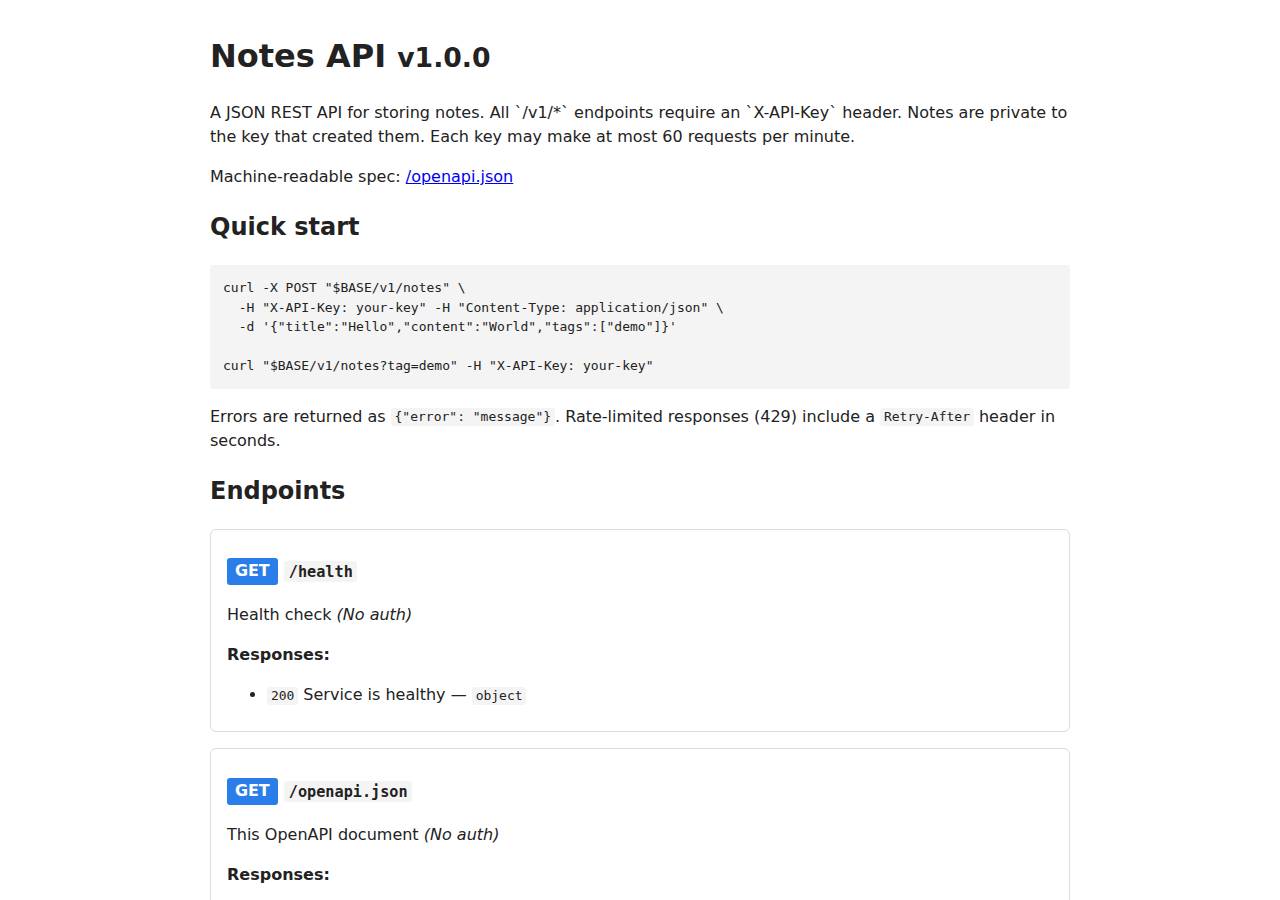
Deployed to https://adb-xaw13-api-web-production.up.railway.app. Every deployment is deleted after it's verified and reviewed.
Screenshots
Technologies
- Runtime
- Node.js 20+
- Frameworks
- Express
- Libraries
- node-postgres
- Packaging
- railway.json
Named from the app's dependencies, Dockerfile and config files, and the cloud resources it created.
Checks
Black-box checks against the live URL. A cell succeeds when every required check passes. The app's spec
| Result | Check | Details |
|---|---|---|
| passed | GET /health answers 2xx within 1 min ready |
|
| passed | The app is served over HTTPS with a valid certificate https |
|
| passed | The app is public: no redirect to another host such as a login page public_access |
|
| passed | GET /health returns {status: ok} health |
|
| passed | GET /openapi.json is an OpenAPI 3 document covering /v1/notes openapi |
|
| passed | GET /docs serves human-readable documentation docs optional |
|
| passed | Requests without an API key get 401 auth_missing |
|
| passed | Requests with an unknown API key get 401 auth_invalid |
|
| passed | POST /v1/notes creates a note create |
|
| passed | Invalid notes are rejected with 400 create_validation |
|
| passed | GET /v1/notes/{id} returns the note get |
|
| passed | GET /v1/notes lists notes and filters by tag list |
|
| passed | Notes are listed newest first list_order optional |
|
| passed | PATCH /v1/notes/{id} updates only the given fields update |
|
| passed | Notes are private to the API key that created them isolation |
|
| passed | DELETE /v1/notes/{id} removes the note delete |
|
| passed | Notes are still there a minute later persistence |
|
| passed | Exceeding 60 requests/minute returns 429 rate_limit |
|
| passed | 429 responses include a Retry-After header rate_limit_retry_after optional |
|
| passed | One key hitting its limit doesn't throttle other keys rate_limit_per_key |
Human steps
- Sign up for an account and verify the email address · 3 min
prerequisite: account setup - Create an API token and hand it to the agent · 2 min
prerequisite: account setup - Add a payment method to the account · 2 min
resources: paid resources: adb-xaw13-api
Stack fit
The same review rated the stack the agent chose, judged against the app's requirements rather than a preferred stack.
Node.js 22 with Express and Railway Postgres fits a small, persistent, key-authenticated notes API well and stays minimal. STACK.md compares sensible alternatives and the build mostly follows it.
| Criterion | Weight | Score | Why |
|---|---|---|---|
| Fit for the job | 40 | 9/10 | Express and pg suit a small JSON CRUD API, and managed Postgres with a volume meets the requirement that data survive restarts and redeploys. The in-memory rate limiter works for the single replica, which deployment.json says to keep. |
| Proportion | 30 | 9/10 | Two runtime dependencies, no ORM, one table and a hand-written OpenAPI document make this about as small as the requirements allow. STACK.md mentions a CDN-hosted Redoc page, but the build serves self-contained HTML instead, which is simpler still. |
| Platform fit | 30 | 9/10 | This uses what Railway does well: a Railpack-detected long-running Node service, a one-click Postgres template linked by variable reference, and a health check in railway.json. railway.json is deprecated config-as-code, but it keeps working until December 2026. |
Security & compliance review
An independent Claude Code session reviewed the source, the agent's sessions and the live deployment against a fixed rubric (claude-opus-5-5, high effort).
The Notes API on Railway is built and deployed carefully. API keys went to Railway variables through stdin, the database URL is a private-network variable reference, every query is parameterized with per-key ownership checks, and the live service exposes no files, debug endpoints or stack traces. The main weaknesses: the Postgres template's public TCP proxy was probably left enabled, the Node runtime, base image and CLI versions aren't pinned, security headers are missing, and failed key guesses aren't rate limited.
| Criterion | Weight | Score | Why |
|---|---|---|---|
| Secrets handling | 25 | 9/10 | API_KEYS was piped to `railway variable set --stdin` and never printed, DATABASE_URL is a Railway variable reference, and .env is excluded by both .gitignore and .railwayignore. One small issue: the Railway account token was interpolated into a curl Authorization header on the command line for the GraphQL rename, though it was masked and never echoed. |
| Deployment provenance | 20 | 7/10 | Local source was deployed with `railway up` and built by Railpack. The live app matches the source, and a package-lock.json existed locally and was uploaded. However, the Node runtime is only constrained by `engines: >=20`, Railpack picks the base image, there is no git-backed source of record, and the CLI was installed with an unpinned `npm i -g @railway/cli`. |
| Terms compliance | 15 | 9/10 | This is a personal side project on a usage-based Railway plan, which allows personal use and keeps services running without sleeping. The Postgres service has a persistent volume. The exact plan tier isn't visible, so I'm not certain of its terms. |
| Least privilege | 15 | 7/10 | The app reaches Postgres over the private network and runs from a Railpack image. The Railway Postgres template normally also creates a public TCP proxy (DATABASE_PUBLIC_URL), and the agent didn't remove it. The app connects as the template's postgres superuser, and the container probably runs as root under Railpack's defaults. |
| Transport security | 10 | 8/10 | HTTPS uses a valid Let's Encrypt certificate, and HTTP gets a 301 redirect to HTTPS. Responses have no HSTS, X-Content-Type-Options, frame protection or CSP; the app could have added these, for example with helmet. |
| Attack surface | 10 | 9/10 | Probes for .env, .git, package.json, source files and admin paths all return the app's JSON 404. Malformed JSON gets a clean 400 with no stack trace, and x-powered-by is disabled. Only the documented public endpoints (/health, /docs, /openapi.json) answer without a key. |
| Application security | 5 | 8/10 | Every query is parameterized, input types are validated, ownership is enforced in each WHERE clause (other keys get 404), the HTML docs escape their output, and the body size is capped at 1 MB. The rate limiter runs only after authentication, so failed key guesses are never throttled. Raw API keys are also stored as owner_key in the database instead of a hash. |
Findings
-
medium deployment Postgres probably reachable through a public TCP proxy
Evidence: deploy.md: `railway add --database postgres` creates Railway's PostgreSQL template, which by default includes a public TCP proxy (DATABASE_PUBLIC_URL). No later step removes it. The app needs only the private DATABASE_URL (deployment.json notes).
Fix: Delete the TCP proxy on the Postgres service so the database is reachable only over Railway's private network.
-
low deployment App uses the database superuser, and the container probably runs as root
Evidence: app/deploy.sh:17 sets DATABASE_URL to `${{adb-xaw13-api-db.DATABASE_URL}}` (the template's postgres user). The Railpack build sets no non-root user.
Fix: Create a role limited to the notes table for the app, and run the container as a non-root user.
-
low deployment Runtime and tooling versions not pinned
Evidence: app/package.json:11-13 `"node": ">=20"`. app/railway.json uses the RAILPACK builder with its default base image. app/deploy.sh:12 `npm i -g @railway/cli` has no version. The deploy came from a local `railway up` with no tracked git source.
Fix: Pin the Node major version (engines or .node-version), pin the CLI version, and deploy from a git repository the owner controls so each deployment traces to a commit.
-
low app Failed API key attempts are not rate limited
Evidence: app/src/app.js:58-65: the auth middleware returns 401 before `v1.use(rateLimit)`, and the limiter is keyed on a valid req.apiKey. Requests with unknown keys are never counted.
Fix: Add a per-IP limiter in front of authentication, or count failed attempts per IP.
-
low app Raw API keys stored in the database
Evidence: app/src/app.js:77 inserts req.apiKey into owner_key, and app/src/db.js:16 defines `owner_key TEXT`. Anyone who can read the database sees valid credentials.
Fix: Store a SHA-256 or HMAC of the key as the owner identifier.
-
low app Security headers missing
Evidence: `curl -sI https://adb-xaw13-api-web-production.up.railway.app/health` returned content-type, etag, server and x-railway-* headers, but no Strict-Transport-Security, X-Content-Type-Options, X-Frame-Options or Content-Security-Policy.
Fix: Add helmet or set these headers in Express middleware.
-
info deployment Account token passed on a command line
Evidence: deploy.md: `curl -s https://backboard.railway.com/graphql/v2 -H "Authorization: Bearer $RAILWAY_API_TOKEN" ...` was used for the service rename. The value is expanded from the environment and was not printed.
Fix: Pass the header from a file (curl -H @file) or use the CLI, so the token doesn't appear in process arguments.
-
info platform HTTPS with HTTP redirect provided by Railway's edge
Evidence: `curl -sI http://.../health` returned 301 to https. The certificate is CN=*.up.railway.app, issued by Let's Encrypt YE2 and valid until Dec 26 2026.
Fix: None needed.
Cloud resources and cost
| Traffic | Per month | How it was priced |
|---|---|---|
| Light use Barely used: a few visits a week, about 2,000 requests a month. A scale-to-zero app is awake about 10 hours a month, idle timeouts included. | $10.56 | memory billed all month, CPU for ~10 h of activity, 0.04 GB egress at $0.05/GB |
| Busy A public app that crawlers, uptime monitors and visitors hit around the clock: one request a second on average, so it never goes idle. | $52.64 | memory billed all month, CPU for ~730 h of activity, 52.6 GB egress at $0.05/GB |
Resources the agent created
| Kind | Name | Plan | List price / month | Pricing |
|---|---|---|---|---|
| project | adb-xaw13-api | 2 service(s) + 0.081 GB volume | $50.01 | 2 service(s) at the assumed 1 vCPU / 0.5 GB each, always on; usage is metered per second so a mostly idle service costs less than this list price |
The agent estimated $5.00 a month.
Code
- Code
- 566 lines in 15 files (JavaScript 547, Markdown 45, JSON 40, Shell 19)
- Dependencies
- 2 npm, 0 Python
- Deploy config
railway.json
The agent's sessions
| Phase | Status | Time | Turns | Tokens | Cost | Shell commands |
|---|---|---|---|---|---|---|
| Build | completed | 2m 52s | 12 | 491.2K | $0.54 | 11 |
| Deploy | completed | 3m 25s | 11 | 669.6K | $0.29 | 10 |
The agent's deploy summary
The Notes API is live at https://adb-xaw13-api-web-production.up.railway.app, and every requirement in TASK.md passed when I tested it through that URL.
What's deployed (Railway project adb-xaw13-api):
adb-xaw13-api-web: the Node/Express app, one instance, deployed from local source withrailway up. It uses a Railway-generated HTTPS address.adb-xaw13-api-db: Railway Postgres with persistent storage. The app connects to it over Railway's private network throughDATABASE_URL.API_KEYS: set to exactly the keys inBENCH_API_KEYS. It went in through stdin and was never printed.- Cost: roughly $5 a month for light traffic on usage-based pricing; the plan's included usage may cover it. No human steps were needed.
Tested through the public URL:
/health,/openapi.jsonand/docsall return200.- A missing or unknown key gets
401. - Create, list, get, update and delete all work, and bad input (empty title, wrong types) gets
400. - The note list is newest first, and the
?tag=filter works. - The second key gets
404when it tries to read, change or delete the first key's notes. - Request 61 within a minute gets
429withRetry-After, while the other key keeps working. - A note created before a redeploy was still there afterwards.
Things to know:
- Rate limiter: it keeps its counts in the app's memory, so they reset on each redeploy, and the web service must stay at one instance.
- Database name: the Postgres template ignored the name I gave it and called the service "Postgres", so I renamed it through Railway's GraphQL API.
deploy.shdoesn't include that rename step. - Config file: the Railway CLI warns that
railway.jsonis deprecated. It keeps working until 2026-12-01; after that the config needs migrating withrailway config migrate. - Test data: the notes I created during testing have been deleted.
10 shell commands during deploy
- 5s
sed -i '/^RAILWAY_API_TOKEN=$/d' .env && cat .env && railway whoami 2>&1; railway list 2>&1 | head - 9s
railway init --name adb-xaw13-api --json 2>&1 | tail -5 && railway add --database postgres --service adb-xaw13-api-db --json 2>&1 | tail -5; railway add --service adb-xaw13-api-web --json 2>&1 | tail - 19s
railway service --help 2>&1 | sed -n '1,30p' - 22s
curl -s https://backboard.railway.com/graphql/v2 -H "Authorization: Bearer $RAILWAY_API_TOKEN" -H 'Content-Type: application/json' -d '{"query":"mutation { serviceUpdate(id: \"375f4b0f-daeb-401c-974b- - 27s
W=adb-xaw13-api-web - 56s
railway domain --service adb-xaw13-api-web --json 2>&1 | grep -v -i 'config as code\|migrate\|keep working'; sleep 20; railway service status --all 2>&1 | grep -v -i 'config as code\|migrate\|keep wor - 1m 33s
cat > /tmp/smoke.sh <<'EOF' - 1m 49s
B=https://adb-xaw13-api-web-production.up.railway.app; K2=$(cut -d, -f2 <<<"$BENCH_API_KEYS") - 3m 08s
railway deployment list --service adb-xaw13-api-web 2>&1 | grep -vi 'config as code\|migrate\|keep working' | head -5; railway status --json 2>/dev/null | python3 -c 'import json,sys;d=json.load(sys.s - 3m 18s
cat > deployment.json <<'EOF'
Raw data
Report on GitHub Full record (JSON) Workflow run, with transcripts