Railway · Opus 5.5 · medium effort · HIPAA organization · trial 1
Real-Time Collaborative App on Railway
Success
Deployed to https://adb-klpuj-realtime-web-production.up.railway.app. Every deployment is deleted after it's verified and reviewed.
Screenshots
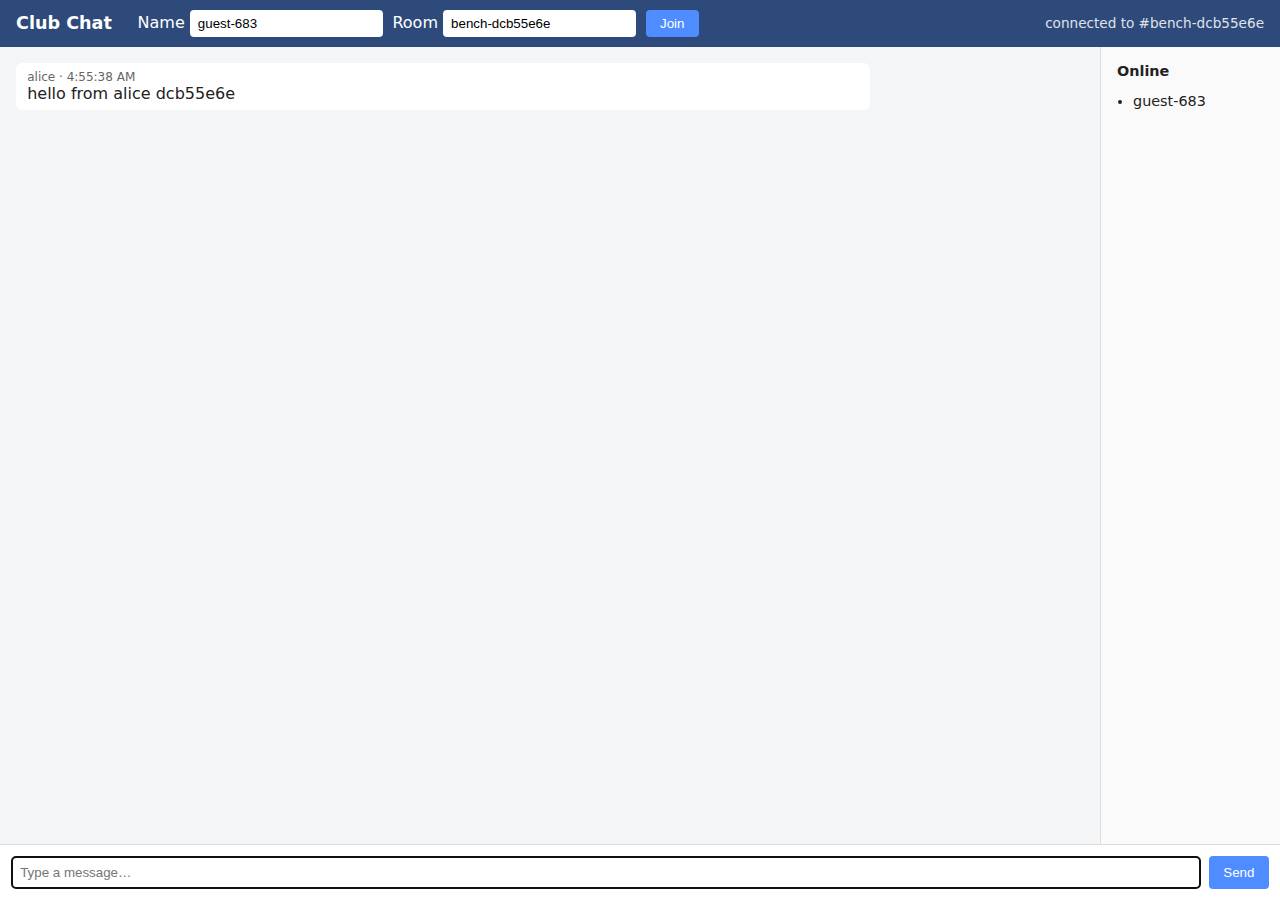
Technologies
- Runtime
- Node.js 20+
- Frameworks
- Node.js http module (built in)
- Libraries
- ws
- Packaging
- railway.json
Named from the app's dependencies, Dockerfile and config files, and the cloud resources it created.
Checks
Black-box checks against the live URL. A cell succeeds when every required check passes. The app's spec
| Result | Check | Details |
|---|---|---|
| passed | GET / answers 2xx within 1 min ready |
|
| passed | The app is served over HTTPS with a valid certificate https |
|
| passed | The app is public: no redirect to another host such as a login page public_access |
|
| passed | GET / serves the chat UI as HTML ui |
|
| passed | deployment.json declares a supported transport (websocket or sse) transport optional |
|
| passed | Clients connect over websocket connect |
|
| passed | A message reaches another client in the same room within 5 s delivery |
|
| passed | The sender receives its own message too echo optional |
|
| passed | Messages never reach clients in other rooms room_isolation |
|
| passed | Five users posting at the same time all see every message within 10 s fanout |
|
| passed | GET /api/rooms/<room>/messages returns recent messages history |
|
| passed | Messages over 1000 characters are rejected validation optional |
|
| passed | The chat UI loads in a browser without errors browser_ui optional |
Human steps
- Sign up for an account and verify the email address · 3 min
prerequisite: account setup - Create an API token and hand it to the agent · 2 min
prerequisite: account setup - Add a payment method to the account · 2 min
resources: paid resources: adb-klpuj-realtime
Stack fit
The same review rated the stack the agent chose, judged against the app's requirements rather than a preferred stack.
A minimal Node.js + ws service on one Railway container fits a small realtime chat well and follows the reasoning in STACK.md. The main gap is in-memory history, which doesn't survive restarts.
| Criterion | Weight | Score | Why |
|---|---|---|---|
| Fit for the job | 40 | 8/10 | Node with `ws` is a good fit for room broadcast over WebSockets, and SSE is there as a fallback. History is kept only in memory, so it's lost on every redeploy or restart. STACK.md accepts that trade-off, and for a hobby club it's tolerable but weaker than a small durable store. |
| Proportion | 30 | 9/10 | One process, one dependency, no framework: about as simple as the requirements allow. The extra SSE path is optional but cheap. |
| Platform fit | 30 | 9/10 | A long-running container suits Railway, and its edge terminates TLS so wss:// works with no setup. The single-replica limit is documented and enforced in railway.json. |
Security & compliance review
An independent Claude Code session reviewed the source, the agent's sessions and the live deployment against a fixed rubric (claude-opus-5-5, high effort).
This is a small single-service Node.js chat app on Railway that handles secrets cleanly and exposes nothing beyond its own routes over valid HTTPS, with HTTP redirected. The main weakness is in the app: an unguarded decodeURIComponent lets one malformed request crash the process, and there's no rate limiting or WebSocket Origin check. Smaller issues are missing security headers, unpinned Railpack/npm build inputs and a root container.
| Criterion | Weight | Score | Why |
|---|---|---|---|
| Secrets handling | 25 | 10/10 | The app needs no secrets. The Railway token came from the environment or a git- and railway-ignored .env, and it never shows up in commands, logs or deployed files. |
| Deployment provenance | 20 | 7/10 | The code in production is the reviewed source, uploaded with `railway up` from the agent's workspace and built by Railpack. But the base image and Node version are whatever Railpack picks (engines is only `>=20`), `ws` is a caret range, and the bundle has no lockfile, so the build inputs aren't pinned. |
| Terms compliance | 15 | 8/10 | This is a personal/club app on an existing Railway account with usage-based billing, and Railway's Hobby/Pro terms allow that. The benchmark couldn't read the exact plan, though. If it's the trial, the credits run out and the service would stop. |
| Least privilege | 15 | 8/10 | There is one service with no data stores, no extra public resources and a single replica. The Railpack-built container runs with the default (root) user, and the agent didn't change that. |
| Transport security | 10 | 8/10 | HTTPS works with a valid Let's Encrypt wildcard certificate, and HTTP gets a 301 redirect to HTTPS. Neither the app nor Railway sets HSTS, CSP, X-Content-Type-Options or frame protection, and the app could easily have added them. |
| Attack surface | 10 | 9/10 | Only /, /health, the room API and /ws respond. /.env, /.git/config, /package.json and /server.js all return a JSON 404, and nothing shows stack traces or directory listings. |
| Application security | 5 | 5/10 | Input checks and DOM rendering are sound (room regex, 1–1000 character text, textContent everywhere). But one malformed percent-encoded room path throws an uncaught URIError that crashes the process, and there is no rate limiting, connection cap or WebSocket Origin check. |
Findings
-
medium app One unauthenticated request can crash the server (uncaught decodeURIComponent)
Evidence: app/server.js:72 calls `decodeURIComponent(m[1])` with no try/catch inside the http request handler. A path like /api/rooms/%E0/messages throws URIError, which is uncaught, so Node exits. railway.json sets restartPolicyType ON_FAILURE with restartPolicyMaxRetries 5, so a few requests could keep the service down and wipe the in-memory history. Judged from the code; I didn't send it to the live service, to avoid causing an outage.
Fix: Wrap the decode in try/catch and return 400. Also add a process-level error guard, or use a router that handles bad encodings.
-
low app No rate limiting, connection limits or room cap
Evidence: app/server.js:78-90 (POST messages) and 110-140 (WebSocket) accept unlimited anonymous posts and connections. getRoom (line 14) creates a room for every new valid name and never evicts it, so memory grows without limit.
Fix: Add per-IP rate limits on posts and connections, cap the number of rooms and SSE/WS clients, and evict rooms that are empty and idle.
-
low app WebSocket upgrade doesn't check Origin
Evidence: app/server.js:110-117 accepts any upgrade on /ws without looking at the Origin header, so any website can open sockets and post as any display name. There's no auth, so the impact is limited.
Fix: Only accept upgrades whose Origin is the app's own host.
-
low app Security headers missing
Evidence: `curl -D - https://adb-klpuj-realtime-web-production.up.railway.app/` returns only content-type, date, server: railway-hikari and x-railway-* headers. There's no Strict-Transport-Security, Content-Security-Policy, X-Content-Type-Options or X-Frame-Options.
Fix: Set HSTS, a strict CSP (the page is self-contained), X-Content-Type-Options: nosniff and frame-ancestors 'none' in the server's responses.
-
low deployment Build inputs not pinned
Evidence: app/railway.json uses builder RAILPACK with its default base image. package.json has `"node": ">=20"` and `"ws": "^8.22.0"`, and the app bundle has no package-lock.json, even though `npm i ws` was run in process/build.md. Deployed with `railway up --service adb-klpuj-realtime-web --ci` straight from the local workspace, with no commit to tie the release to.
Fix: Commit and deploy package-lock.json (npm ci), pin the Node major version, and deploy from a tagged git commit or a Dockerfile with a digest-pinned base image.
-
low deployment Container runs as the default root user
Evidence: The build goes through Railpack (railway.json `builder: RAILPACK`) and no non-root user is configured. The build log in process/deploy.md shows apt packages being installed into the image.
Fix: Use a Dockerfile with `USER node`, or set a non-root user for the Railpack image.
-
info deployment Account plan not confirmed
Evidence: process/context.json shows `account: {}`. deployment.json says the plan is the "existing account plan (unchanged)", with costs that 'free or included credits may cover'.
Fix: Confirm the account is on the Hobby (or higher) plan, not a trial whose credits expire, so the club's chat stays up.
Cloud resources and cost
| Traffic | Per month | How it was priced |
|---|---|---|
| Light use Barely used: a few visits a week, about 2,000 requests a month. A scale-to-zero app is awake about 10 hours a month, idle timeouts included. | $5.28 | memory billed all month, CPU for ~10 h of activity, 0.04 GB egress at $0.05/GB |
| Busy A public app that crawlers, uptime monitors and visitors hit around the clock: one request a second on average, so it never goes idle. | $27.63 | memory billed all month, CPU for ~730 h of activity, 52.6 GB egress at $0.05/GB |
Resources the agent created
| Kind | Name | Plan | List price / month | Pricing |
|---|---|---|---|---|
| project | adb-klpuj-realtime | 1 service(s) | $25.00 | 1 service(s) at the assumed 1 vCPU / 0.5 GB each, always on; usage is metered per second so a mostly idle service costs less than this list price |
The agent estimated $1.00 a month.
Code
- Code
- 329 lines in 10 files (JavaScript 218, HTML 98, JSON 43, Markdown 21, Shell 13)
- Dependencies
- 1 npm, 0 Python
- Deploy config
railway.json
The agent's sessions
| Phase | Status | Time | Turns | Tokens | Cost | Shell commands |
|---|---|---|---|---|---|---|
| Build | completed | 1m 27s | 7 | 256.0K | $0.32 | 6 |
| Deploy | completed | 1m 30s | 8 | 383.4K | $0.18 | 7 |
The agent's deploy summary
The app is live at https://adb-klpuj-realtime-web-production.up.railway.app, and every requirement in TASK.md passed when I tested it through that URL.
What I created: a Railway project adb-klpuj-realtime with one Node.js web service, adb-klpuj-realtime-web, running a single copy on the free *.up.railway.app domain. Railway provides the HTTPS/WSS. I estimate the cost at about $1 a month; that's a guess, not a quote, and Railway's included credits may cover it. Nothing needed a person, so human_steps is empty, and deployment.json is written with realtime set to wss://adb-klpuj-realtime-web-production.up.railway.app/ws.
Tested through the public URL:
- Web page:
GET /returns 200 and serves the chat page. - WebSocket: two users each sent 10 messages at the same time, and all 20 reached both of them, the slowest in about 145 ms. A user in another room received none, and messages arrived in the required format.
- Bad messages: empty and 1001-character messages got 2 error replies over WebSocket and
400over HTTP. - HTTP posting and history: a valid POST returned
201, and the history endpoint returned the room's messages oldest first. - Server-Sent Events: the stream returned
text/event-streamand delivered a posted message straight away.
Limitations:
- Chat history is kept in memory, so it's lost on every redeploy or restart.
- The service has to stay at one copy, because each room's messages live in that one process.
- The Railway CLI warns that
railway.jsonis deprecated and keeps working only until 2026-12-01. After that, the config needs migrating withrailway config migrate.
7 shell commands during deploy
- 3s
railway whoami 2>&1; railway list 2>&1 | head - 7s
railway init --name adb-klpuj-realtime 2>&1 | tail -3 && railway add --service adb-klpuj-realtime-web 2>&1 | tail -3 && railway service adb-klpuj-realtime-web 2>&1 | tail -2 - 12s
railway status --json 2>/dev/null | python3 -c 'import json,sys;d=json.load(sys.stdin);print(d["name"],d["id"]);[print(e["node"]["name"],e["node"]["id"]) for e in d["services"]["edges"]]' - 19s
railway up --service adb-klpuj-realtime-web --ci 2>&1 | grep -v -i 'config as code\|migrate\|keep working' | tail -15 - 57s
railway domain --service adb-klpuj-realtime-web 2>&1 | grep -i http - 1m 10s
cat > /tmp/remote.js <<'EOF' - 1m 23s
cat > deployment.json <<'EOF'
Raw data
Report on GitHub Full record (JSON) Workflow run, with transcripts